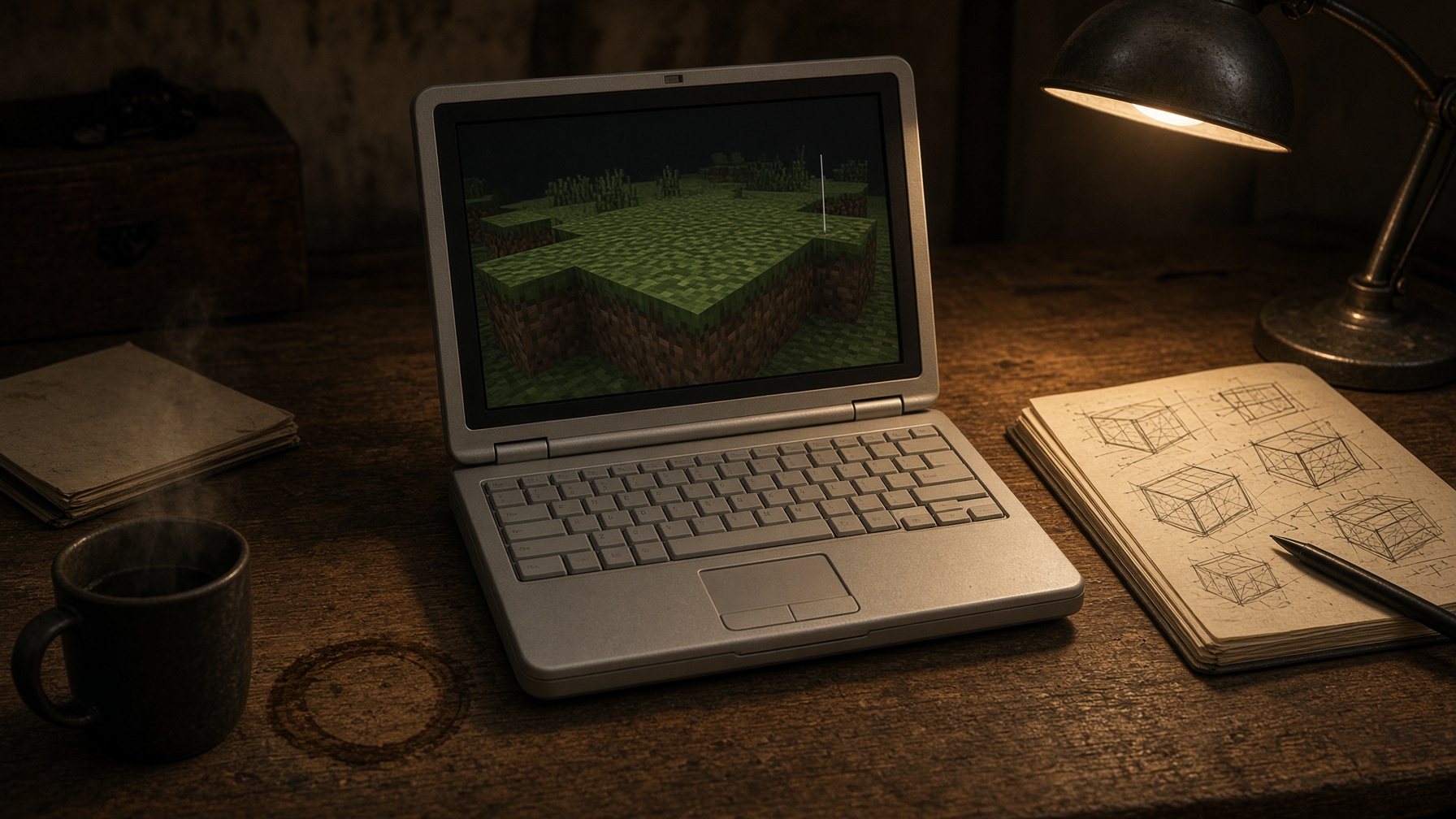
If you only remember one date, make it 17 May 2009: the first public alpha. Everything after that is the same idea under more lighting — infinite cubic worlds, tools you craft yourself, and other people eventually showing up in them.
The shape of the story
May 2009
Cave Game
Markus “Notch” Persson prototypes a 3D block builder in about a week, inspired by Infiniminer, Dwarf Fortress and a childhood love of Lego. On 17 May he posts a public build to the TIGSource indie forums. People come back the next day.
2009–2010
Classic, Survival, Alpha
The project picks up a name — Minecraft — and modes. Classic is creative building in a browser. Survival Test adds health and monsters. Indev and Infdev invent infinite worlds, then Alpha (June 2010) is sold as a download. Notch quits his day job. The Halloween Update that October adds biomes and the Nether.
Dec 2010
Beta, and a million copies
Beta ships on 20 December 2010. Redstone, beds and maps arrive over the next year. In January 2011 sales pass one million while the game is still unfinished. Mojang AB is incorporated in Stockholm with Jakob Porsér and CEO Carl Manneh.
18 Nov 2011
Minecraft 1.0 at Minecon
Full release happens on stage in Las Vegas. The End and the Ender Dragon give the sandbox a destination, to mixed reaction. Notch steps back from lead design in December; Jens “Jeb” Bergensten takes over.
2012–2014
Every screen
Xbox 360 Edition (2012) introduces a huge console audience. Pocket Edition lands on phones. Raspberry Pi, PlayStation and Windows Phone follow. By 2014 the game has sold tens of millions of copies.
15 Sep 2014
Microsoft buys Mojang
Microsoft acquires Mojang and the Minecraft IP for US $2.5 billion in cash. Notch leaves. Jeb remains the creative centre of Java Edition. The bet is that a game already this large can live on every Microsoft (and later, every) platform.
2016–2017
Better Together / Bedrock
Pocket, Windows 10, Xbox One and later Switch and PlayStation are unified on the Bedrock engine. Cross-play, Realms and the Marketplace become the default for anyone not on Java. Java stays the home of mods.
2019
Best-selling game
Minecraft overtakes Tetris on copies sold. The Village & Pillage update remakes villagers, raids and the trading loop that still structures mid-game survival.
2020–2023
Spin-offs and 300 million
Minecraft Dungeons (2020) is a dungeon crawler. Caves & Cliffs and The Wild reshape the underground and the deep dark. Guinness records 300 million copies in October 2023. Minecraft Legends tries real-time strategy. Minecraft Earth is shut down. Education Edition becomes a fixture in classrooms.
2025–2026
A film, and still growing
A Minecraft Movie (2025) opens as a global hit, later approaching a billion dollars at the box office. Copies sold are now counted in the region of 400 million. Monthly players remain in the hundreds of millions. The next drop is always a few weeks away.
Who makes it now
Mojang Studios in Stockholm still develops Minecraft, as part of Xbox Game Studios. Java Edition and Bedrock Edition ship on overlapping calendars. Feature names (the next “drop”) are announced at Minecraft Live and Minecraft Monthly. The independent Minecraft Wiki is the historical record of every snapshot.
Notch is no longer involved. The public story of the game after 2014 belongs to the studio, the community, and the people who still punch a tree on a Sunday night.
Why it lasted
Other sandboxes have better lighting. Minecraft lasted because the unit of play is tiny (one block), the systems compose (redstone, farms, datapacks, mods), and the culture is portable — a YouTube series, a classroom, a wedding build, a server that has been online since 2012. It is closer to a medium than to a single game.